
We are the lead investor in eight promising companies that can change the future








Ferries are the dirtiest ships afloat.
What if they could all be electrified?
A Swedish company headquartered in Stockholm that designs and builds all-electric boats and ferries that rise up out of the water on wing-like foils, reducing friction between the hull and water by 80%. The drop in friction allows a dramatic increase in range, making all-electric battery-powered boats realistic. Only small underwater wings are needed to lift a hull out of the water because water is 800-times denser than air. Thus, lifting a Boeing 747 fuselage requires an underwater wing 800-times smaller than the wing it needs to fly in air. Candela ferries are revolutionizing commuter routes as cities adopt waterways instead of expensive roads and trains to move people and goods.
Ocean Zero is the lead investor in a Series A round and has supported a Series B.
What if the cheapest CO2 abatement came not from wind or solar, but from sails on ships?
A French company founded by noted naval architect Marc van Peteghem invented a set of sails shaped like airplane wings that helped win the 2010 America’s cup for Larry Ellison. From Wikipedia: “The rigid wing sail of USA 17 provided a decisive advantage and Golden Gate Yacht Club won the 2010 America’s Cup by a considerable margin.” Van Petteghem founded Oceanwings to extend the concept to large cargo ships. The company’s Wingsails® are far different from classic fabric sails. They are tall and rectangular, built of composites in a factory that makes wind turbine blades. A ship can be retrofitted with four WingSails in two days.The world’s first large cargo ship equipped with OceanWings—MV Canopée—went into service two years ago on an Atlantic-crossing route. Although not fully optimized for Wingsails, it has burned about 40% less fuel with 99% system availability. A new ship designed to maximize savings could reduce fuel burn by 50%. The payback period would be less than two years, and OceanWings are designed to last 30 years.
Ocean Zero was the lead investor in Series A and supported Series B
What if millions of the dirtiest engines on the planet could become silent and fumeless?
Headquartered in Bristol, RI, Flux Marine has designed the world’s only high efficiency, all-electric, high horsepower outboard marine motor. One Flux 115 hp motor mounted on a typical center console 23-foot pleasure boat, can deliver a full day of boating without recharging, and offer a 40 mile range at planing speeds. The company’s motors are designed from the start as purely electric propulsion without considering legacy internal combustion engine designs. The motors do not draw in sea water or expel it, emit no gasses, are whisper quiet, use a revolutionary belt drive instead of 90-degree bends in geared shafts, and incorporate Flux’s proprietary battery designs and battery management systems. Flux motors are completely safe from electric shock and can actually be operated underwater. They require no maintenance or winterization. Flux offers individual motors or curated boat packages available in dual console, center console, and rigid hull inflatables. Partner boat manufacturers include Highfield. Scout, and Zodiac.
Ocean Zero was the lead investor in a Series A round and supported a Series B
What if you could reduce the hull friction of large ocean going ships by 50%?
This Norwegian company has invested more than 20 years developing air lubrication as a means of reducing the friction between a boat and water. Overcoming friction is a key factor in creating an electric vessel with significant range. Pascal has designed an automated system with a single high-volume, low-pressure pump in the bow that delivers air through a single slit to a shallow cavity in the hull, allowing about half the boat’s hull to float on a cushion of air. Pascal’s all-electric design has been proven in multiple sizes of boats from 8 meters to 20 meters, with documented effects of 50% energy savings. The technology is scalable to ocean-going cargo vessels and could reduce their CO2 emissions by 20%-30%. A Norwegian government supported design of an all-electric workboat for Norway’s aquaculture industry that incorporates Pascal’s cavity-based air lubrication system debuted in 2025 to great acclaim. The design is simple and remarkably robust. Pascal’s technology is being incorporated in electric water taxis in the Netherlands and its Empirica analysis system for existing air lubrication systems on large ships has been subscribed to by major shipping companies. The design is ideal for work boats, pleasure craft, and large ships alike. Although Pascal has been focused on smaller craft to grow the company quickly, its technology is rapidly being adapted to ocean-going cargo vessels and could massively reduce their CO2 emissions.
Ocean Zero was the lead investor in a Seed round and a Series A raise.
What if a commute on a ferry could be a sublime experience?
There are tens of thousands of rivers, bays and harbors in the world where a high-volume, short-run, all-electric passenger ferry service would make life better. Commuter times could be cut by more than 50%, auto traffic congestion would dissipate, and urban transit users would enjoy their passages instead of resenting them. And now imagine that the ferry itself is a beautiful addition to the cityscape? The first Hyke electric ferry was launched two years ago and the response from passengers is overwhelmingly enthusiastic. Hyke ferries carry 50 passengers, are quiet, graceful, environmentally friendly, designed for autonomy, emit no CO2 or other gasses, dock themselves, and can run on solar power all day. Designed by Eker Group, Norway’s world-famous industrial design firm, they are a joy to experience.
Ocean Zero has participated in three funding rounds.
What if a modern high-tech battery could hold 2x as much energy as the best battery in the world and cost 30% less to manufacture?
This startup emerging from the renowned Max Planck Society in Germany has invented a technology and unique fabrication process that allows lithium ion batteries to store twice as much energy, recharge in half the time, and be built far cheaper than the finest batteries anywhere. Batteries are essential to Ocean Zero’s focus because better batteries will enable greater range and power for ocean shipping. Combined with advanced air lubrication systems for hulls and wind propulsion, better batteries will allow the leap from fossil-fueled ships to all-electric ships, and avoiding transitional fuels such LNG, emethanol and ammonia. The company is the brainchild of Dr. Joachim Spatz, Director of the Max Planck Institute for Medical Research and a scientific member of the Max Planck Society. He has been developing the technology at Max Planck for more than a decade.
Ocean Zero is a co-lead investor in a Seed round and an investor in a Series A raise.
What if the world’s 4 million fishing trawlers could cut their emissions by 70%?
This Halifax company’s remarkable electric hybrid drive system for diesel fishing trawlers, commercial cargo ships and yachts can reduce CO2 emissions dramatically, eliminate almost all the noise aboard that often deafens deck hands, eradicate fumes, and save owners more than half their operating costs. Glas Ocean’s electric drive is a drop-in unit brilliantly engineered in cooperation with British Aerospace Engineering that is easily installed between a diesel power plant and a ship’s propeller. This hybrid drive system allows efficient use of the diesel to get offshore, but then offers days of electric propulsion while fishing. In addition, Glas Ocean’s Performarine data and AI-based performance analysis system provides operators with route and propulsion suggestions in real time, gathering wave, current, weather, and other variables.The system collects data based on each vessel’s history at sea to finely hone future operations. When in port, multiple Glas Ocean batteries on boats are easily connected together to store wind and solar output for extended baseload electricity use, especially in smaller towns that might not otherwise be able to afford such infrastructure.
What if you could travel 24 hours a day, 7 days a week continuously on solar power alone?
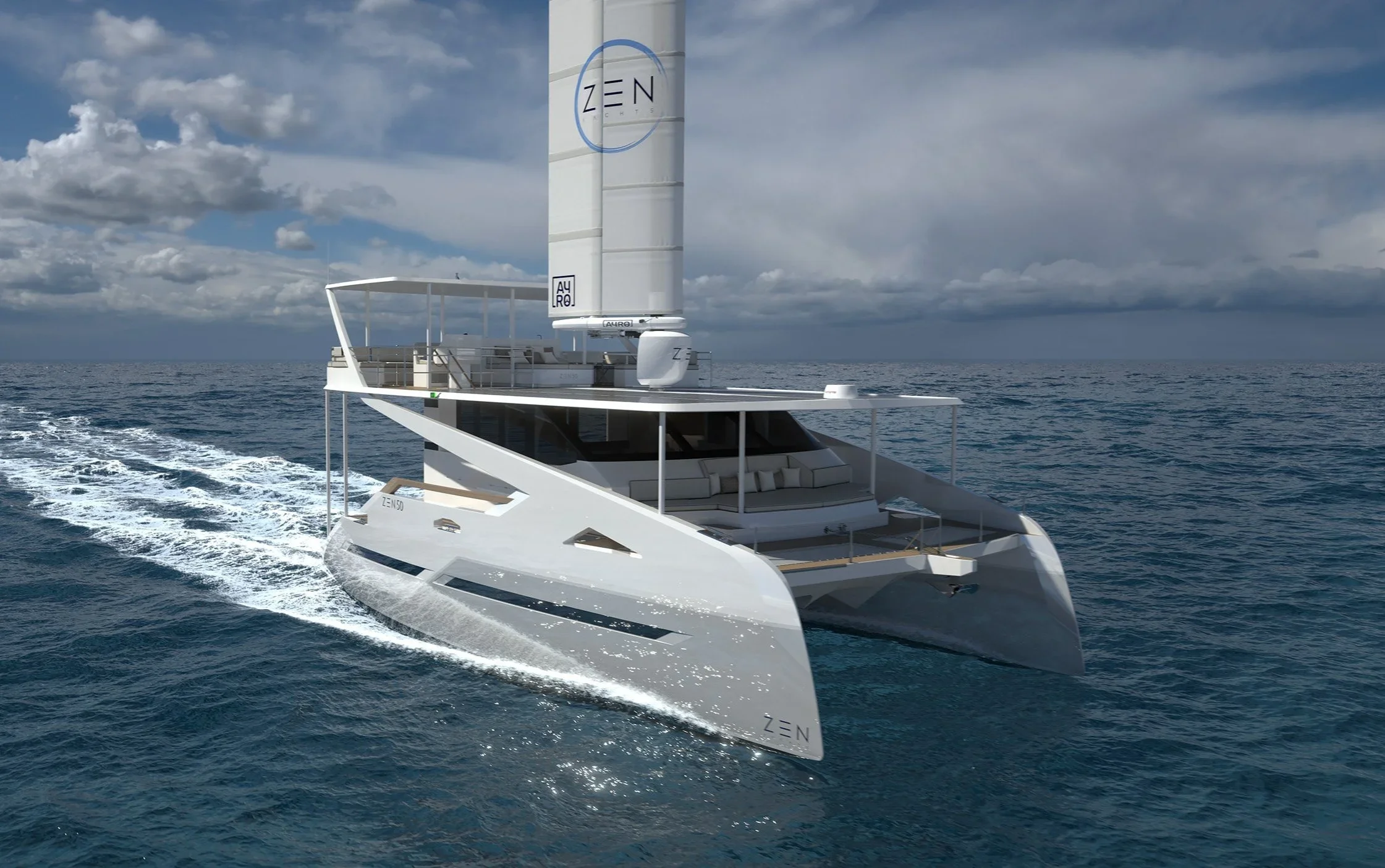
Imagine a yacht that can circle the globe, traveling constantly, without a drop of fossil fuel aboard, without hydrogen or fuel cells or ammonia, without any kind of generator, without ever plugging into a charger, without any operational carbon footprint, and even do it without sails? That’s not a dream. The first ZEN 55 catamaran will begin ocean trials this spring, the beginning of a line of totally solar powered yachts with unlimited range. The boats also can be configured with Oceanwings Wingsails that are fully computerized, require no attention, and can double the average speed of the yacht. Wingsails allow a boat to point almost directly into the wind—within 10 degrees. Imagine a yacht that can sail within 340 degrees of a 360 degree circle no matter where the wind is coming from. Or not—just motor on indefinitely despite dark cloudy days, long nights, and whatever Mother Nature throws at you—all on sun power.
Ocean Zero took the entire Series A round.